Building Stability Before You’re Forced to Do It Under Pressure
There is a quiet misconception many people carry about aging:
that preparation is only necessary once something starts going wrong.
A diagnosis. A fall. A hospitalization. A financial emergency.
But for adults aging without built-in support systems, waiting until a crisis happens often creates far more stress than the crisis itself.
Because when there is no spouse automatically stepping in, no adult child coordinating details, and no close relative nearby to absorb confusion, preparation becomes less about perfection and more about preserving stability.
Not fear.
Not catastrophe.
Stability.
And while that can sound emotionally heavy at first, many people eventually discover something surprising:
planning ahead often creates relief.
Aging Alone Requires More Intentional Systems
For people with strong family structures, many forms of support happen informally.
Someone notices problems early. Someone helps organize paperwork. Someone advocates during difficult moments. Someone checks in after procedures or emergencies.
When those structures are absent, life often remains entirely manageable — until something becomes complicated unexpectedly.
That is why solo aging preparation is not really about “old age.” It is about reducing vulnerability during uncertainty.
The goal is not to predict every possible future scenario.
The goal is to avoid preventable chaos.
Start With the Areas That Create the Most Stress Later
One reason people procrastinate planning is because they imagine they need to solve their entire future all at once.
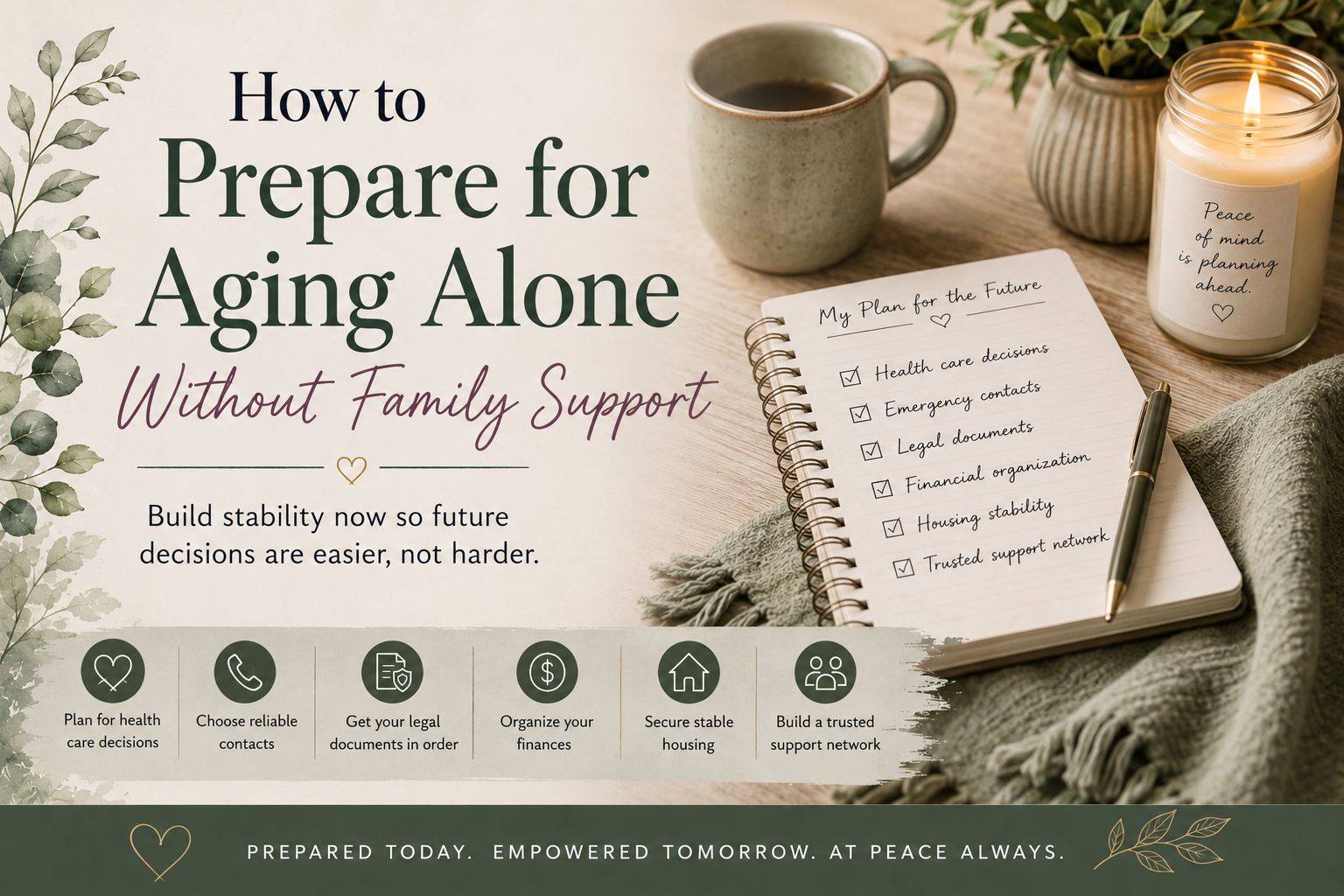
But the most effective preparation usually begins with a few foundational areas:
- healthcare decisions
- emergency contacts
- legal authority
- financial organization
- housing stability
- trusted support relationships
You do not need a color-coded binder system overnight.
You simply need enough clarity that future decisions become easier instead of harder.
One of the Most Important Questions Is: “Who Actually Knows Anything?”
Many independent adults manage their lives privately and efficiently for decades.
But emergencies expose hidden gaps quickly.
If something happened tomorrow:
- Would anyone know your medications?
- Would someone know how to access your home?
- Would your important documents be findable?
- Would anyone understand your wishes?
- Would the right people be contacted — or the wrong ones?
These questions are not meant to create anxiety. They are meant to create awareness.
Because awareness creates options.
Support Does Not Need to Look Traditional to Be Real
One of the more freeing realizations for many solo agers is understanding that support systems do not have to mirror traditional family structures in order to be meaningful.
Support may come from:
- close friends
- neighbors
- community groups
- faith communities
- professional advocates
- carefully cultivated relationships
In some cases, chosen support systems become more reliable than biological family ever was.
What matters most is not whether support looks conventional.
What matters is whether it is trustworthy, realistic, and sustainable.
Financial Organization Is Emotional Protection Too
People often think of financial planning as purely practical. But for solo agers, organization frequently becomes emotional protection as well.
Disorganization creates vulnerability:
- missed bills
- inaccessible accounts
- confusion during emergencies
- difficulty if temporary incapacity occurs
Simple systems matter more than complicated ones.
Even basic preparation helps:
- updated beneficiary information
- organized passwords
- automatic bill pay
- clear account documentation
- emergency financial instructions
The calmer your systems are, the less overwhelming future disruptions become.
Planning Early Preserves More Independence
Ironically, people who avoid planning often lose options sooner.
The earlier decisions are made:
- the more flexible they can be
- the more intentional they become
- the more independence tends to remain
Preparation is not surrendering control.
In many ways, it is the opposite.
It is deciding thoughtfully while life is still relatively calm, instead of leaving important choices to exhaustion, panic, or institutional systems later.
Final Thoughts
Preparing for aging alone is not about assuming the worst.
It is about acknowledging reality compassionately and responding to it wisely.
You do not need to become obsessed with the future.
You do not need to solve everything immediately.
And you do not need to create a perfect life plan overnight.
You simply need to begin.
Because even small forms of preparation create something many people are truly searching for:
a greater sense of steadiness inside uncertainty.