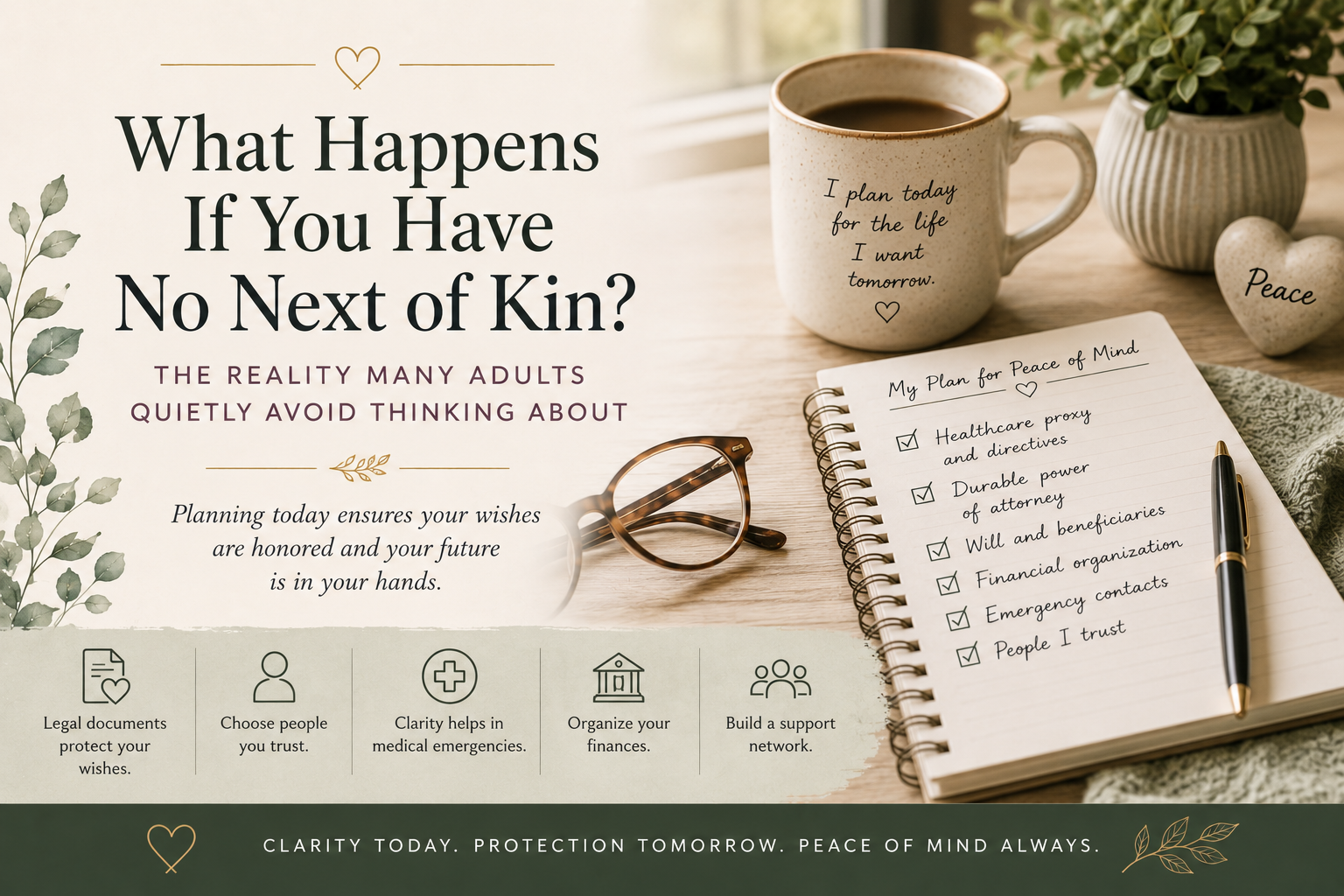
The Reality Many Adults Quietly Avoid Thinking About
Most people assume someone will automatically step in during a crisis.
A spouse.
An adult child.
A sibling.
A relative somewhere nearby who will “handle things” if life becomes complicated.
But for millions of adults, that assumption simply is not true.
Some people never had strong family support to begin with. Others are widowed, child-free, geographically isolated, or estranged from relatives entirely. And many eventually realize that the people technically considered “family” are not people they would actually trust to make decisions during vulnerable moments.
Which raises an uncomfortable but important question:
What actually happens if you have no next of kin?
The answer is not always catastrophic. But it does become significantly more important to prepare intentionally.
“No Next of Kin” Creates Practical Complications — Not Moral Failure
There is often shame attached to this subject, even though there should not be.
Our culture tends to treat strong family support systems as universal, when in reality many adults move through life without reliable built-in safety nets.
Not having next of kin does not mean:
- you failed
- you are unloved
- you made bad choices
- your life lacks meaning
It simply means your planning may need to be more deliberate.
And honestly, many people with large families are far less prepared than solo agers who have thoughtfully considered these realities early.
Hospitals, Financial Systems, and Legal Systems Often Default to Family Structures
One reason this issue matters is because many institutions are still designed around traditional assumptions.
During emergencies, organizations often look for:
- spouses
- children
- siblings
- immediate relatives
Without clear documentation, decision-making can become slower, more confusing, or inconsistent with your wishes.
This becomes especially important in situations involving:
- hospitalization
- temporary incapacity
- long-term care
- financial management
- end-of-life decisions
The less clarity that exists ahead of time, the more institutional systems tend to fill the gaps for you.
Legal Documents Matter More Than Most People Realize
One of the most empowering things solo agers can do is create legal clarity before it becomes urgently necessary.
This may include:
- healthcare proxies
- medical directives
- powers of attorney
- wills
- beneficiary designations
- emergency contact documentation
These documents are not just paperwork.
They are instructions about who you trust, how you want decisions handled, and what kind of future you want protected.
Without them, decisions may default to people or systems you would not have chosen yourself.
Support Can Be Intentionally Created
One of the more hopeful realities many adults eventually discover is that support systems do not have to be inherited in order to be real.
People often build meaningful support through:
- friendships
- neighbors
- community groups
- faith communities
- chosen family
- professional advocates
- long-term reciprocal relationships
In some cases, intentionally built support structures become far more stable than biological family systems ever were.
What matters most is not whether support looks traditional.
What matters is whether it is trustworthy and sustainable.
Preparing Early Protects Future Independence
Ironically, proactive planning often preserves more autonomy, not less.
People who organize early usually maintain:
- greater decision-making control
- more housing flexibility
- stronger financial clarity
- reduced emergency chaos
- more emotional steadiness during difficult moments
Preparation does not eliminate uncertainty.
But it dramatically reduces unnecessary vulnerability.
Final Thoughts
Realistically confronting the possibility of aging without next of kin can feel emotionally heavy at first.
But clarity is often far less frightening than avoidance.
You do not need to solve every future scenario overnight.
You do not need a perfect support system immediately.
And you do not need to force relationships that have never truly felt safe or dependable.
You simply need to begin creating enough structure that your future is guided by intention instead of assumption.