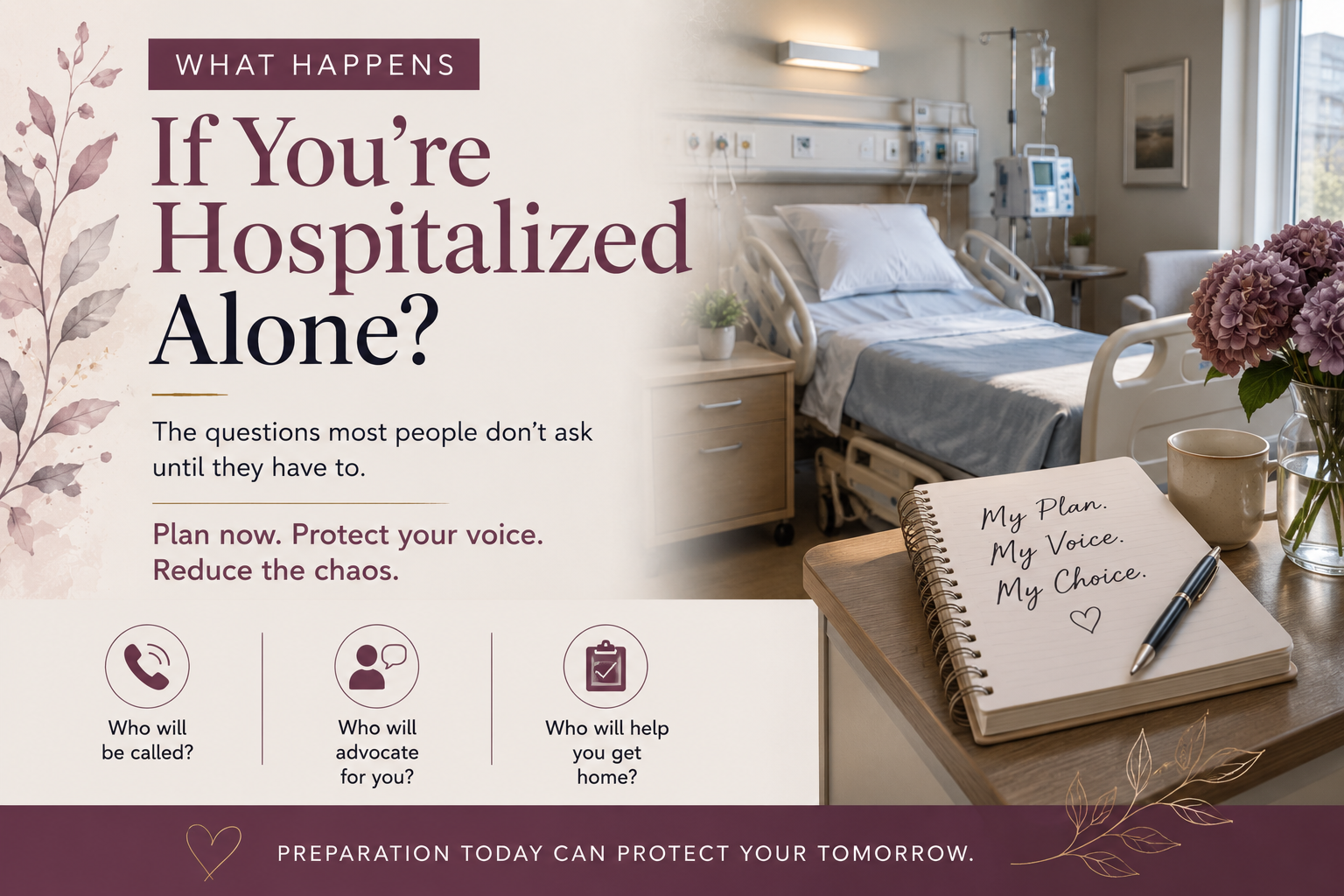
The Questions Most People Don’t Ask Until They Have To
There is a certain kind of vulnerability that only becomes visible in medical settings.
Even people who are fiercely independent often discover this unexpectedly. A procedure is scheduled. An emergency happens. A doctor begins asking questions quickly. Forms appear. Someone asks:
“Who should we call?”
And suddenly, what once felt abstract becomes very real.
For adults aging without built-in support — including people who are single, widowed, child-free, or estranged from family — hospitalization can carry a layer of logistical and emotional complexity that many healthcare systems are simply not designed around.
Not because hospitals are intentionally unkind. But because most systems quietly assume someone else will eventually enter the room.
Someone to advocate.
Someone to remember details.
Someone to drive you home.
Someone to notice when something feels wrong.
When that person does not automatically exist, planning ahead becomes far more than paperwork. It becomes a form of protection.
Hospitals Are Built Around Assumptions
Most hospitals function with an invisible expectation that patients have support systems.
This shapes everything from:
- discharge procedures
- transportation requirements
- medication instructions
- emergency decision-making
- post-operative care expectations
In many cases, medical staff are kind and resourceful. Social workers may help. Nurses often try to bridge gaps wherever possible.
But hospitals are still fast-moving environments. And when no clear support structure exists, important things can become harder:
- communication
- advocacy
- continuity of care
- emotional reassurance
- decision-making under pressure
This is especially true during moments when patients are medicated, overwhelmed, frightened, or unable to advocate clearly for themselves.
One of the Hardest Realizations Is Practical, Not Emotional
Many people expect the hardest part of hospitalization alone to be loneliness.
Sometimes it is.
But often, the harder part is logistical vulnerability.
Who has your medication list?
Who knows your medical history?
Who can access your home if needed?
Who notices if discharge instructions don’t make sense?
Who questions a rushed decision if you are exhausted or confused?
These are not dramatic questions. They are deeply practical ones.
And practical gaps are often what create the most stress during health crises.
Emergency Contacts Matter More Than Most People Realize
For many solo agers, emergency contact forms can trigger a quiet kind of panic.
Some people realize they have no obvious answer. Others list relatives they do not actually trust. Some rotate between acquaintances and hope it never becomes relevant.
But emergency contacts are not symbolic. They are functional.
The right emergency contact is not necessarily:
- your closest relative
- your oldest friend
- the person who “should” help
The right emergency contact is someone who:
- answers their phone
- stays reasonably calm
- understands your wishes
- can communicate clearly during stress
- is realistically willing to show up
Sometimes that person is family. Sometimes it absolutely is not.
A Healthcare Proxy Is Different — And Important
One of the biggest misunderstandings people have is assuming an emergency contact automatically has decision-making authority.
They do not.
A healthcare proxy (or medical power of attorney, depending on the state) legally authorizes someone to make medical decisions if you become unable to communicate.
Without this documentation, hospitals may default to next-of-kin structures that do not reflect your actual relationships, wishes, or emotional safety.
For estranged adults especially, this distinction matters enormously.
Choosing a healthcare proxy is not about predicting catastrophe. It is about making sure your voice remains represented if you temporarily cannot speak for yourself.
Preparation Reduces Fear More Than Avoidance Does
Many people avoid thinking about hospitalization because the subject feels frightening.
But uncertainty is often more anxiety-producing than preparation.
There is a profound emotional difference between:
“I hope this never happens”
and
“If it does happen, at least some things are already handled.”
That preparation does not need to be elaborate.
Often, meaningful readiness begins with very small things:
- a clearly listed emergency contact
- organized medication information
- healthcare documents completed
- someone who has a spare key
- written instructions stored somewhere accessible
These are not glamorous tasks. But they create stability during moments when stability matters most.
Independence and Support Are Not Opposites
This is important to say clearly.
Many people fear planning for support because it feels like surrendering independence. But needing systems is not weakness. It is reality.
No one remains fully self-sufficient forever. Not because they failed, but because human beings are not designed to move through illness, aging, or crisis entirely unsupported.
The goal is not dependence.
The goal is thoughtful interdependence — structured in ways that feel safe, intentional, and aligned with your actual life.
Final Thoughts
Hospitalization has a way of exposing the difference between assumptions and plans.
For people aging without built-in support, that difference matters.
Not because disaster is inevitable. But because emergencies become less chaotic when important decisions have already been considered calmly, ahead of time.
You do not need to prepare for every possible scenario overnight.
But asking:
“Who’s got me if something happens?”
…is not fear-based thinking.
It is one of the most grounded and self-respecting questions a person can ask.